The TCS London Marathon is one of the six Abbott World Marathon Majors and, by most measures, the most subscribed road race on earth — with a record 1,133,813 people entering the ballot for the 2026 edition alone. The race takes place on Sunday, April 26, 2026, starting with staggered wave starts from 9:35am in the Greenwich and Blackheath area, covering the full 26.2 miles before finishing on The Mall in front of Buckingham Palace.
Running 26.2 miles is one of the most physically demanding things a human body can do in a single day. The weeks of training, the race itself, and the days that follow place extraordinary demands on your muscles, joints, immune system, and hydration reserves. That’s exactly why IV drip therapy London Marathon recovery services have become an increasingly essential tool for serious runners — from first-timers crossing the finish line on adrenaline alone, to seasoned marathoners chasing personal bests who refuse to spend the following week unable to walk downstairs. IV therapy doesn’t just help you recover faster. Used strategically, it helps you arrive at the start line better prepared and leave the finish line with a shorter road back to feeling human again.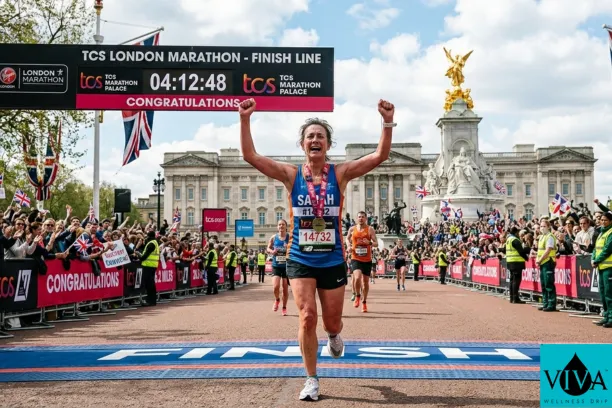
What Running the London Marathon Actually Does to Your Body
The TCS London Marathon course winds through the heart of the capital — starting in leafy Blackheath, heading east through Charlton and Woolwich, passing the Cutty Sark in Greenwich around miles six and seven, crossing the River Thames at Tower Bridge, looping around Canary Wharf and the Isle of Dogs, and finishing past the London Eye, the Shard, and Buckingham Palace. It is one of the most iconic routes in world running — and also a 26.2-mile test of everything your body has stored.
During endurance sports, blood flow is directed away from the digestive system and toward working muscles, sweat is produced to cool the body consuming water and electrolytes, and muscles are exerted to their limits leading to minute damage to cells and tissues. After prolonged periods of exertion lasting 90 minutes or more, the body begins releasing the stress hormone cortisol, which affects the immune system.
For the average London Marathon finisher — most of whom complete the race well within the 6.5-hour mark — that translates to hours of sustained physiological stress. The specific damage done includes:
- Severe dehydration: Runners can lose 1–3 litres of fluid per hour through sweat depending on temperature and pace, depleting blood volume and impairing muscle and organ function
- Critical electrolyte loss: Sodium, potassium, magnesium, and calcium are lost through sweat — many marathon runners experience symptoms of hyponatremia (low sodium levels) due to excessive sweating and water intake, while magnesium depletion drives post-race muscle cramps and tightness
- Muscle fibre micro-tears: Running long distances causes tiny tears in muscle fibers leading to inflammation and soreness that can persist for days without targeted recovery support
- Glycogen depletion: Every runner knows the “wall” — the point where glycogen stores are exhausted and the body begins burning fat and muscle tissue for fuel
- Immune suppression: Intense physical exertion can temporarily weaken your immune system, making you more susceptible to illness — many runners experience post-marathon colds or flu-like symptoms due to suppressed immune function
Oral hydration after crossing the finish line faces a significant obstacle: drinking too much water can dilute needed electrolytes, and the digestive system and kidneys are temporarily weakened and less able to process fluids normally — many marathon runners who drink large quantities of fluid immediately after a run find themselves vomiting it up because their digestive system cannot process it at that moment.
This is the precise gap that IV drip therapy London Marathon recovery fills.
Why IV Drip Therapy Is the Gold Standard for Marathon Recovery
IV therapy delivers fluids, vitamins, and minerals directly into the bloodstream, bypassing the digestive system — allowing athletes to achieve faster hydration and nutrient absorption that is crucial during and after intense marathon competition. Your body absorbs 100% of every active ingredient immediately, with effects typically felt within 30–45 minutes.
IV drips restore lost fluids much faster than a person could drink a gallon of water — even if their digestive system were working properly. Delivering fluids, electrolytes, and vitamins intravenously immediately after prolonged strenuous exercise quickly replenishes depleted resources without further stressing the digestive system or kidneys.
For a runner who has just completed one of the world’s greatest marathons, that speed of delivery is not a luxury — it is a clinically meaningful advantage that directly compresses recovery time.
Best IV Drip Formulas for London Marathon Runners
- Marathon Recovery Drip: The cornerstone formula — full electrolyte repletion including sodium, potassium, magnesium, and calcium alongside rapid fluid restoration and anti-inflammatory support to address the acute physiological damage of 26.2 miles
- Hydration Drip: Isotonic saline or lactated Ringer’s solution for rapid fluid and electrolyte restoration — essential when the digestive system cannot reliably process oral fluids post-race
- Muscle Repair Drip: BCAAs (branched-chain amino acids) assist in muscle repair and recovery, reducing downtime between races or training sessions , paired with Vitamin C, Magnesium, and anti-inflammatory agents to address micro-tear damage
- Immunity Booster: Vitamin C and Zinc can enhance immune cell function and reduce the likelihood of post-race illness — critical protection for the immune suppression window that typically follows marathon exertion
- Energy Restoration Drip: B12, B-complex, and amino acids to address the deep cognitive and physical fatigue that can leave even well-trained runners struggling to function in the days following race day
The London Marathon IV Protocol: Before, During & After
The smartest runners don’t treat IV drip therapy London Marathon as a post-race emergency. They build it into their race-week strategy as a deliberate performance tool — treating recovery as part of the race preparation, not an afterthought.
Pre-Race: The Running Show Week (April 22–25)
The TCS London Marathon Running Show takes place at ExCeL London from Wednesday April 22 through Saturday April 25 — race week begins well before the start gun. A pre-race Hydration + Energy drip scheduled two to three days before race day tops up your electrolyte stores, ensures your muscle cells are fully hydrated at the cellular level before the starting line, and primes your immune system for the physical stress ahead.
Using IV therapy in preparation for an endurance event not only ensures the body has the right fluids and nutrients, but has them immediately available during the race rather than waiting for them to be processed by the digestive system. Runners who arrive at Blackheath already optimally hydrated at a cellular level have a measurable physiological advantage over those who rely on race-morning water intake alone.
Race Day: April 26
Average April temperatures in London range from 10 to 15 degrees Celsius, making conditions generally favourable for fast times — but even in ideal conditions, 26.2 miles of sustained exertion will deplete your body significantly. The London course has a well-documented trap: runners go out too hard because the first half feels easy and the atmosphere is electric — and the physiological cost of that early pace mistake is typically felt acutely in the final miles and the days that follow.
Post-Race Recovery: April 27–28
This is where IV drip therapy delivers its most transformative impact for London Marathon runners. Fatigue, muscle soreness, dehydration, and delayed recovery are common challenges for endurance athletes even after meticulously prepared races — and the standard recovery playbook of rest, fluids, and food takes three to five days to restore baseline function.
A post-race Recovery Drip booked for the morning of April 27 — ideally delivered to your hotel room or London accommodation — addresses all five major physiological deficits simultaneously: fluid, electrolytes, muscle repair nutrients, immune support, and anti-inflammatory protection. Runners who use IV therapy post-marathon report waking up the following morning feeling genuinely recovered — significantly better than after previous races completed without IV support.
Finding the Best Mobile IV Drip for London Marathon
When searching for IV drip near me or the best IV therapy London Marathon available, clinical credentials and safety standards must be your primary filter. A reputable mobile IV provider will employ only licensed physicians or registered nurses as infusion practitioners, use pharmaceutical-grade sterile components and single-use equipment, conduct a pre-treatment health intake before every session, and operate in alignment with Infusion Nurses Society (INS) clinical standards for safe IV administration.
At Viva Wellness Drip, every session is delivered by a licensed healthcare professional using sterile, single-use equipment. Every formula is personalized through a pre-treatment consultation. We bring everything directly to your London hotel, apartment, or accommodation — no clinic visit needed when you’re barely able to walk the morning after 26.2 miles.
For group bookings, multi-session race-week packages, and event wellness options for running clubs and charity teams, our event services page covers everything available for London Marathon week.
Pricing, Booking & What Every Marathoner Should Know
Mobile IV drip therapy in London typically ranges from £130–£280 per session, depending on formulation and add-on boosters — options like additional Glutathione push, NAD+ for deeper cellular recovery, or Myers’ Cocktail upgrades. Multi-session packages covering pre-race and post-race drips offer better per-drip value, and group rates are available for running clubs, charity teams, and training partners racing together.
Book before race week. Around 56,000 runners crossed the finish line of the 2025 London Marathon — making it the largest marathon held anywhere in history — and with 1.1 million ballot entrants for 2026, demand for mobile wellness services across London on April 26–27 will be extraordinary. Same-day and next-morning availability cannot be guaranteed during marathon weekend.
It is also worth noting that according to published research in the British Journal of Sports Medicine, commonly agreed upon clinical indications for IV fluids post-marathon include replacement for clinical dehydration and support for athletes experiencing nausea, persistent cramping, or inability to ingest oral fluids — all symptoms that are extremely common in the hours following race completion, and all effectively addressed by a properly administered post-marathon IV drip delivered by a licensed professional.
Make IV Drip Therapy Part of Your London Marathon Race Plan
The London Marathon is one of the Abbott World Marathon Majors — and this could be the start of your six-star journey. You have trained for months, committed to the distance, and earned your place on that start line in Greenwich. The finish line on The Mall in front of Buckingham Palace is one of the most iconic moments in world running. You deserve to cross it fully prepared and recover from it fully supported.
IV drip therapy London Marathon is the recovery tool that closes the gap between what 26.2 miles takes from your body and how quickly you can take it back. Book your pre-race and post-race sessions before you travel to London, protect the months of training you’ve invested in this day, and give yourself every possible advantage — from Blackheath to The Mall and every step of the recovery that follows.
People Also Ask: FAQs About IV Drip Therapy for London Marathon
1. What is the best IV drip for London Marathon recovery?
The ideal protocol combines a pre-race Hydration + Energy drip two days prior with a Recovery Drip on April 27. The post-race formula should focus on electrolytes, anti-inflammatories, and BCAAs to accelerate muscle repair and rehydration.
2. Can I get a mobile IV drip delivered to my London hotel after the marathon?
Yes, mobile services deliver directly to your hotel or home, taking about 30–60 minutes. This is the most practical choice for runners, as it avoids navigating post-race road closures and heavy transport demand when mobility is limited.
3. How much does IV drip therapy cost during London Marathon weekend?
Mobile sessions in London typically range from £130 to £280. Most providers offer discounted pre-race and post-race packages or group rates for running clubs and charity teams.
4. Is IV drip therapy safe to use for marathon recovery?
It is safe for healthy adults when administered by licensed physicians or nurses following INS clinical standards. Clinical literature supports IV therapy for runners dealing with post-race dehydration or nausea that makes oral intake difficult.
5. When should I book IV drip therapy for TCS London Marathon 2026?
Book at least two weeks before the April 26 race date. With over 50,000 finishers and millions of spectators, mobile wellness slots fill up rapidly, so securing your pre- and post-race sessions early is essential.