Amsterdam earns its reputation as one of the most liveable cities in Europe — and it earns it through movement. The city is built for cyclists and pedestrians in a way that most urban environments only aspire to, and its residents take full advantage. A typical Amsterdam day covers more ground on two wheels or two feet than most cities cover in a car — canal bridges, cobblestone streets through the Jordaan, the long flat stretches of the Vondelpark, the density of the Negen Straatjes packed into a few walkable blocks. It is a city that keeps its people genuinely active, often without their noticing how much.
That accumulated physical output — combined with Amsterdam’s famously variable weather, its position as one of Europe’s most visited cities, and the particular demands of its professional and cultural calendar — creates a recovery need that most residents and visitors address inadequately. IV drip Amsterdam services exist to close that gap: clinical hydration and nutrient replenishment delivered to your door, without requiring you to navigate the city one more time to access it.
What Amsterdam’s Pace Actually Costs the Body
The physical demands of Amsterdam are subtle in a way that makes them easy to underestimate. Nobody finishes a day in the city feeling like they’ve run a marathon. What they feel, typically, is a slow accumulation — slightly heavier legs by late afternoon, a dullness that settles in behind the eyes around the third consecutive evening of engagement, the particular fatigue of a city that offers so much that saying no to any of it feels like a waste.
Amsterdam’s climate compounds this. The Netherlands sits in a maritime zone that produces significant atmospheric pressure variability — weather fronts move through quickly, and the combination of wind, humidity, and cold that characterises the city from October through April places consistent low-grade physiological stress on residents and visitors who are spending time outdoors, cycling, or simply navigating the city on foot.
According to research published by the National Institutes of Health, sustained physical activity, cold weather exposure, and psychological load collectively accelerate the depletion of magnesium, B-vitamins, and Vitamin C — the micronutrients most central to energy metabolism, immune function, and recovery. In a city where the baseline activity level is genuinely high and the social and professional calendar tends to run dense, that depletion accumulates faster than most people replenish it through food and rest alone.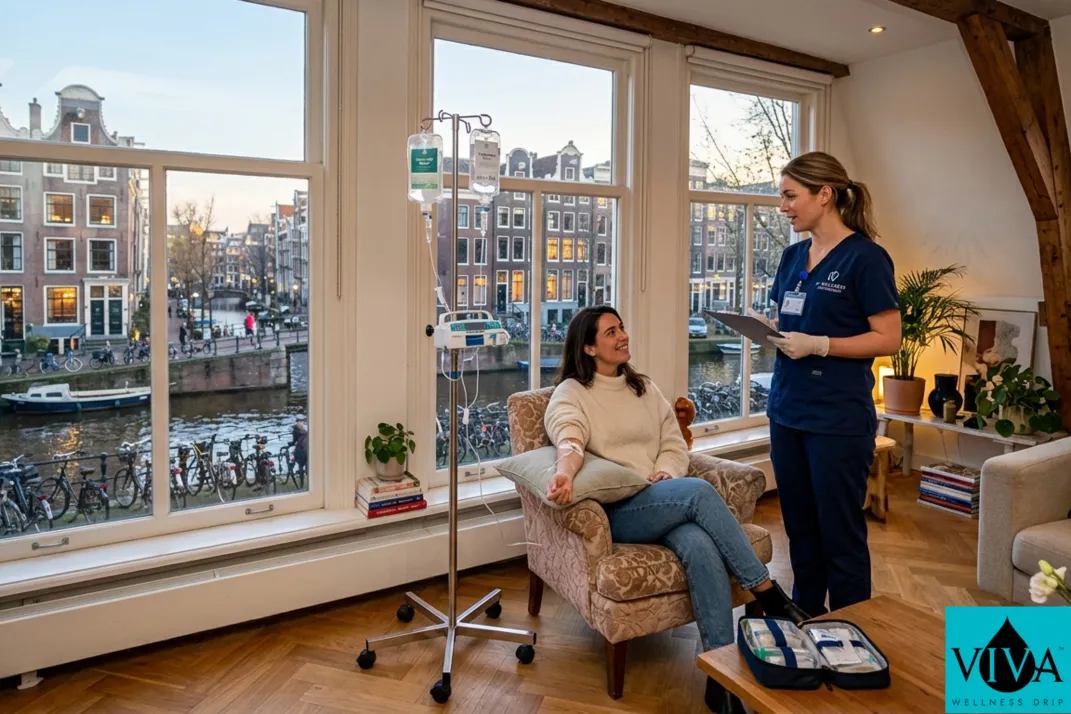
What IV Drip Therapy Delivers — and Why the Delivery Route Matters
The clinical case for IV therapy Amsterdam is straightforward. An intravenous infusion bypasses the digestive system entirely, delivering fluids and nutrients directly into the bloodstream at near-100% bioavailability. Oral hydration and supplements — regardless of quality — pass through the gastrointestinal tract at a fraction of that absorption rate, a process subject to variability from stress, dietary patterns, and gut health.
Every session begins with an isotonic saline base: a sterile solution calibrated to the body’s cellular environment, enabling rapid fluid absorption without inflammatory response. The therapeutic components layered on top are determined by a health assessment completed before every appointment, with formulations reviewed by a supervising physician and sessions administered by a registered nurse or paramedic.
Rehydration and Electrolyte Restoration
Cycling and walking across a city as geographically active as Amsterdam generates consistent electrolyte loss — even in cool weather, where the absence of obvious sweat masks the depletion taking place. Sodium, potassium, and magnesium are the primary electrolytes involved in muscle function, nerve transmission, and fluid balance regulation. Magnesium participates in over 300 enzymatic reactions, including sleep quality regulation, cortisol management, and muscle recovery — and its depletion is consistently linked to the fatigue and disrupted sleep that high-activity urban residents experience without a clear cause.
Intracellular electrolyte restoration through IV delivery addresses this at the tissue level — reaching the muscle and neurological systems directly, rather than the partial and time-delayed absorption that even well-formulated oral supplements provide.
B-Vitamins and Sustained Cognitive Energy
B-complex vitamins — B12, B6, and the full B-family — support mitochondrial energy production and sustained neurological function. PubMed-indexed research consistently links suboptimal B-vitamin status to cognitive fatigue and impaired performance in otherwise healthy, active adults. For Amsterdam professionals managing demanding schedules in one of Europe’s most active business and creative hubs — the city hosts a significant concentration of European headquarters, tech companies, and creative agencies — intravenous B-vitamin delivery ensures therapeutic dosing without the absorption variability of oral supplementation.
Immune Support Through the Dutch Seasons
Amsterdam’s autumn and winter are genuinely challenging from an immune perspective. The city’s density, its position as a major European transit hub through Schiphol, and the cold and damp that characterise the Dutch off-season create sustained immune pressure for residents and visitors alike. High-dose Vitamin C and glutathione precursors address oxidative stress and support cellular immune function — providing the proactive immune resilience that is increasingly characteristic of how wellness-aware Amsterdammers approach the months between October and March.
How Mobile IV Therapy Works Across Amsterdam
The team at Viva Wellness Drip brings medically directed IV therapy directly to your location — a canal house apartment in the Grachtengordel, a hotel suite near Museumplein, a serviced residence in De Pijp, or anywhere across the city’s compact and navigable geography. A registered nurse or paramedic administers every session. A supervising physician reviews the formulation. Sessions run 45 to 60 minutes.
In our experience working with clients in dense European cities, the mobile model is particularly well-suited to Amsterdam’s specific geography. The city’s canal ring and cycling infrastructure make it uniquely accessible for mobile services — a wellness professional can reach virtually any location in the central city efficiently. For residents who have already cycled across the city twice before noon, and for visitors who have covered the Rijksmuseum, the Anne Frank House, and the Albert Cuyp Market in a single day, the concept of a recovery service that arrives rather than requiring travel to it lands with particular clarity.
A brief health screening is completed before each appointment — certain conditions require physician clearance as standard clinical protocol for any medically directed IV service. Eat something light beforehand and wear comfortable clothing with easy sleeve access. The session itself is the restorative interval in an Amsterdam day — most clients read, rest, or allow the city’s pace to pause around them for the first time since arrival.
The Mayo Clinic identifies intravenous delivery as the gold standard for rapid fluid and nutrient replenishment because absorption is independent of gastrointestinal function — a meaningful clinical advantage for anyone whose body is managing the compound demands of sustained urban activity, variable weather, and the immune pressure of a high-traffic international city.
IV Drip Amsterdam: Recovery Built for the Way This City Moves
Amsterdam’s liveability is real — but it is an active liveability, built on movement, engagement, and the particular energy of a city that treats cycling to work, walking to dinner, and staying out late as entirely compatible parts of the same day. Maintaining that pace across a full week, a full season, or a full professional year requires a recovery approach that is as deliberate as the lifestyle itself.
Mobile IV drip therapy in Amsterdam fits that approach precisely. Clinical hydration, electrolyte restoration, immune support, and energy replenishment — delivered to your canal house or hotel, administered by qualified professionals, matched to what your body specifically needs at this point in the week or season.
Whether you’re a resident managing the cumulative demands of Amsterdam’s active professional and social calendar, a visitor trying to extract everything the city offers from a compressed itinerary, or a traveller arriving through Schiphol with jet lag and a full first day already scheduled — IV therapy in Amsterdam is built for the way this city actually operates.
Explore the full menu of IV drip services and find the formulation that fits where you are right now. The canals will still be exactly as they are when the session is done — and you will be ready to meet them properly.
Frequently Asked Question
What is mobile IV drip therapy and how does it work in Amsterdam?
Mobile IV drip therapy delivers clinical-grade intravenous hydration and nutrients directly to your location — canal house apartment, hotel suite, or office. A licensed medical professional administers the session on-site over 45 to 60 minutes, with no clinic visit or commute required.
Why is IV therapy relevant for people living or staying in Amsterdam?
Amsterdam’s cycling and walking culture, variable maritime climate, and dense professional and social calendar generate consistent electrolyte and nutrient depletion — often without the obvious signals that prompt people to compensate. IV therapy replenishes fluids and key micronutrients at near-100% bioavailability, restoring function faster than oral hydration or supplementation alone.
Is mobile IV therapy in Amsterdam medically supervised?
Yes. Every session is administered by a registered nurse or paramedic and overseen by a licensed supervising physician. A health screening is completed before each appointment to confirm eligibility and ensure the formulation is clinically appropriate for your specific recovery needs.
How does IV therapy support immune health during Amsterdam’s winter months?
Amsterdam’s autumn and winter combine cold, damp conditions with the immune pressure of a major European transit hub. High-dose Vitamin C and glutathione precursors delivered intravenously address oxidative stress and support cellular immune function — providing proactive immune resilience that oral supplementation cannot match for absorption speed or efficiency.
Who benefits most from IV drip therapy in Amsterdam?
IV therapy is well-suited for active residents managing Amsterdam’s high-output professional and social calendar, visitors covering the city’s cultural density on foot and by bike, and travellers arriving through Schiphol managing jet lag alongside a full first-day itinerary. It’s particularly effective when recovery time is limited and the next day demands full physical and cognitive engagement.