Most IV therapy menus are written to sell rather than to inform. Names evoke a feeling; the ingredient list, when it exists at all, sits three clicks deep in smaller type.
That is backwards. The components are the product. Here are the five that appear in nearly every professional formulation, what each actually does, and where the evidence is strong versus thin.
1. The Base Fluid: Normal Saline or Lactated Ringer’s
The ingredient nobody markets and everybody needs
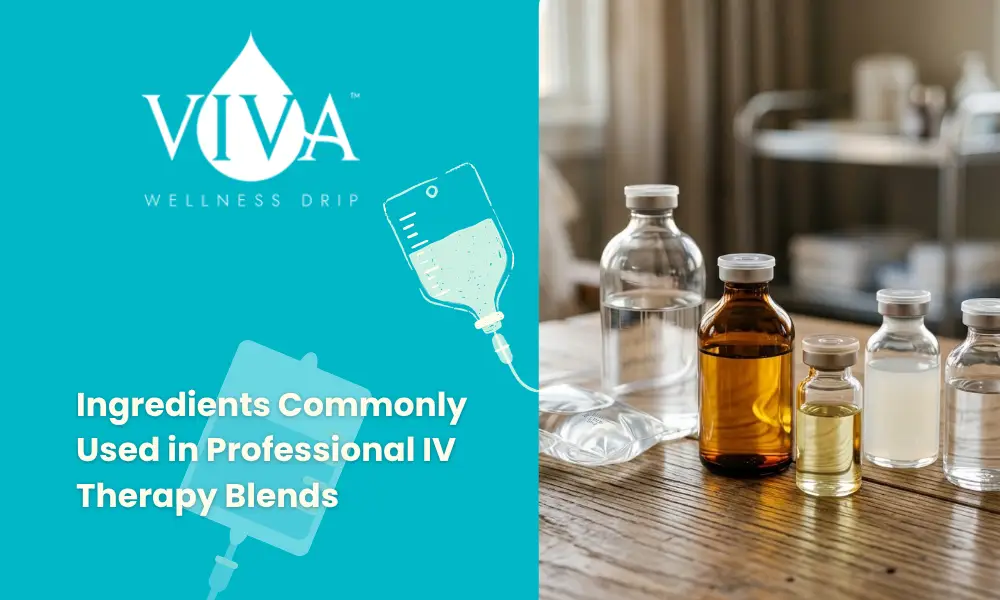
Before a single vitamin enters the discussion, you are receiving 500 to 1,000 mL of isotonic crystalloid — either 0.9% sodium chloride or lactated Ringer’s solution, which additionally contains potassium, calcium, and lactate as a buffer.
For genuine dehydration, this is the therapy. Everything else is additive. Any provider treating the base fluid as an afterthought has the priorities inverted.
Why the choice between them matters
Lactated Ringer’s more closely resembles plasma composition and is often preferred for larger-volume replacement. Normal saline is simpler and entirely appropriate for most wellness indications. Either is legitimate; a provider who cannot tell you which they use is not.
2. B-Complex and Vitamin B12
The workhorse of nearly every blend
B vitamins — thiamine, riboflavin, niacinamide, pantothenic acid, pyridoxine, and cyanocobalamin or methylcobalamin — appear in almost every professional formulation because they function as cofactors in energy metabolism.
The honest framing: repletion helps meaningfully in people who are deficient. The NIH clinical fact sheet on vitamin B12 is clear that deficiency is common in specific groups — older adults, people on metformin or long-term acid suppression, those following strict vegan diets, and anyone with malabsorption. For someone with normal levels, additional B12 is largely excreted.
3. Ascorbic Acid (Vitamin C)
Widely used, frequently overstated
Vitamin C appears in most immune and recovery blends, typically at doses well above what oral intake achieves, because intravenous delivery bypasses the intestinal transport saturation that limits oral absorption.
Two things matter clinically. First, high-dose intravenous vitamin C requires G6PD deficiency screening beforehand, because it can precipitate haemolysis in affected individuals. Second, the NIH fact sheet on vitamin C documents both the genuine differences in pharmacokinetics between oral and intravenous routes and the limits of what that translates to clinically.
A provider that administers high-dose vitamin C without asking about G6PD is skipping a real safety step.
4. Magnesium
The ingredient people feel
Magnesium sulphate or magnesium chloride appears in most comprehensive blends and is frequently the component clients notice most — a warm flush through the chest and face during administration, which is expected and harmless when infused at an appropriate rate.
It contributes to muscle function, nerve conduction, and hundreds of enzymatic reactions. The NIH clinical fact sheet on magnesium notes that dietary intake is inadequate in a substantial portion of the population, though it also makes clear that dietary correction is sufficient for most people and intravenous repletion is for genuine deficits.
This is also why infusion rate matters. Magnesium pushed quickly is uncomfortable, and in the wrong patient, unwise.
5. Glutathione
The most requested, least settled
Glutathione is an endogenous tripeptide antioxidant produced by the liver, and it appears as a standalone push or an additive in most detox- and skin-oriented formulations, including blends such as Glutathione Detox.
Frame it accurately. Glutathione is a legitimate and important molecule in cellular redox balance. The clinical evidence for intravenous supplementation in healthy people is evolving rather than established, and your liver performs detoxification whether or not you supplement. It is a reasonable addition for someone who understands that. It is not a reset button.
What a Professional Blend Looks Like
| Component | Typical Role | Evidence Strength |
| Isotonic base fluid | Volume and electrolyte replacement | Strong |
| B-complex and B12 | Energy metabolism cofactors | Strong in deficiency |
| Ascorbic acid | Antioxidant, immune support | Moderate; route matters |
| Magnesium | Muscle, nerve, enzymatic function | Strong in deficiency |
| Glutathione | Cellular antioxidant | Early and evolving |
| Zinc | Immune function | Strong in deficiency |
| Antiemetic (ondansetron) | Nausea control | Strong, symptomatic |
Pro Tip: The fastest way to judge a provider is to ask what the base fluid is. Everyone can recite their vitamin list — it is the marketing. Far fewer can immediately tell you whether they use normal saline or lactated Ringer’s and why. That question separates operations built around clinical protocol from operations built around a menu design.
Additives You Should Ask About Specifically
Zinc, and prescription components
Zinc appears in most immune formulations such as Immune Boost, and the evidence supports its role in immune function — most clearly in people who are deficient.
Antiemetics like ondansetron are prescription medications and their inclusion is a strong signal that a real medical order stands behind the formulation. So is any mention of a compounding pharmacy as the source.
Reading a Menu Properly
Ask for the base fluid, every additive with its dose, the source of the solutions, and whether supplies are single-use. A menu that answers all four is a menu you can evaluate.
We publish the full composition of every formulation across our complete service menu for exactly this reason. If you want help matching components to a specific goal, ask us rather than guessing from a name — that is a conversation Viva Wellness Drip is happy to have before you book anything.
Frequently Asked Questions
What is the most important ingredient in an IV drip?
The base fluid. For genuine dehydration, isotonic saline or lactated Ringer’s provides the therapeutic effect; the vitamins are additive.
Is IV vitamin C safe for everyone?
Not without screening. High-dose intravenous vitamin C requires G6PD deficiency screening beforehand, as it can cause haemolysis in affected individuals.
Why does magnesium cause a warm feeling?
It causes peripheral vasodilation, producing a flush through the chest and face. It is expected, harmless, and less pronounced when the infusion runs at an appropriate rate.
Does glutathione lighten skin?
Claims around skin effects are not well established clinically, and glutathione’s documented role is as a cellular antioxidant. Treat marketing claims in this area with caution.
Are IV vitamins better than oral supplements?
Only in specific circumstances — malabsorption, documented deficiency, or when intestinal transport limits absorption. For most well-nourished people, oral supplementation is adequate and considerably cheaper.