There’s a particular kind of exhaustion that only Prairie winter produces. It’s not the dramatic crash of overtraining or the acute misery of a flu — it’s the slow, cumulative grind of five months of cold, darkness, dry air, and a body that’s been quietly compensating since October. By February, most Edmontonians aren’t sick exactly. They’re just running well below where they know they can be.
At-home IV therapy Edmonton is built for precisely this window. Not for emergencies, not for dramatic interventions — for the sustained, low-friction replenishment that keeps you functional, clear-headed, and genuinely well through the season that tests everyone.
What “Long Winter Recovery” Actually Means Physiologically
Edmonton’s winter isn’t a single event. It’s a compounding process that unfolds across months, and it affects the body in overlapping layers that most people address one at a time — or don’t address at all.
Sun exposure drops sharply by late October. Without adequate ultraviolet B radiation, the skin cannot synthesize vitamin D3 endogenously, and dietary intake rarely compensates for the shortfall. Research catalogued by the National Institutes of Health links sustained vitamin D insufficiency to immune dysfunction, low mood, poor sleep architecture, and reduced insulin sensitivity — a cluster of effects that compound through a season rather than resolve on their own.
Meanwhile, forced-air heating systems running continuously through Alberta winters reduce indoor relative humidity to levels that drive passive transepidermal fluid loss — meaning you’re dehydrating steadily even on days when you haven’t left the couch. Most Edmontonians aren’t drinking enough to offset this, partly because cold air blunts the thirst response. The result is chronic low-grade dehydration that affects intracellular fluid balance, cognitive performance, and physical recovery in ways that are real but diffuse enough to be easy to dismiss.
Add the immune pressure of cold-season viral exposure, the disrupted circadian rhythms from reduced daylight, and the musculoskeletal strain of cold-weather movement, and what you have is a body running a persistent deficit across multiple systems simultaneously.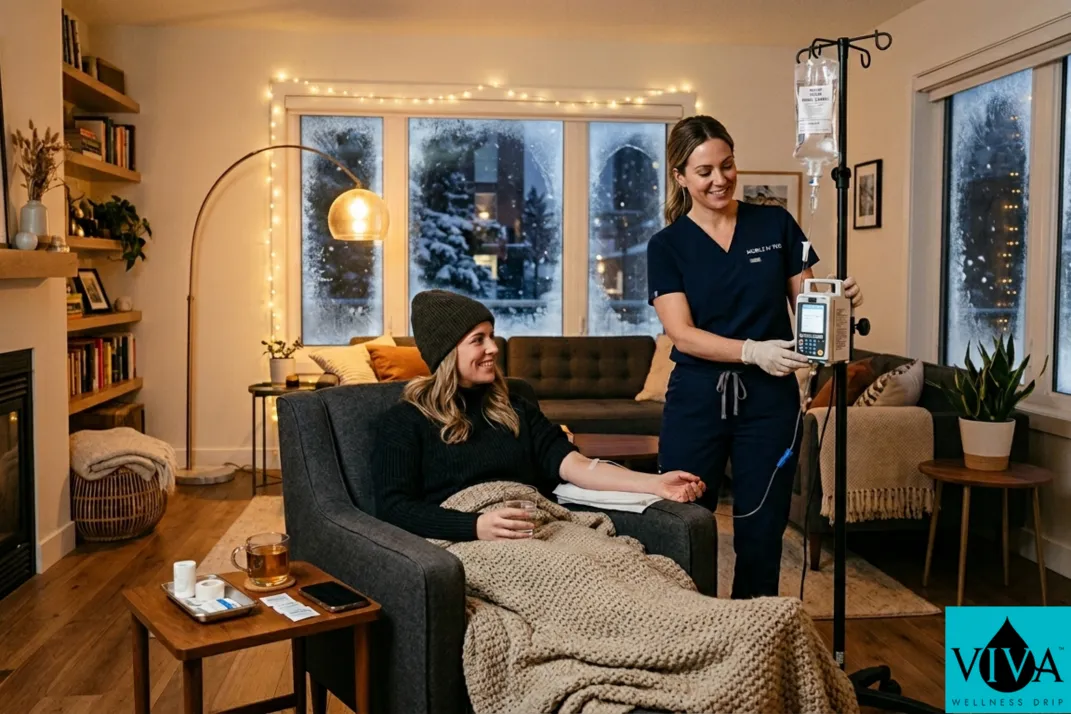
How At-Home IV Therapy Addresses the Winter Stack
Immune System Support When It Matters Most
The window between November and March is when Edmonton’s immune demands peak. Cold-season viruses circulate aggressively, indoor crowding increases transmission risk, and the vitamin D and zinc deficiencies that accumulate through autumn reduce immune surveillance at precisely the wrong time.
An IV infusion protocol incorporating high-dose vitamin C, zinc, and glutathione precursors delivers immune-supporting compounds at bioavailability rates that oral supplementation cannot approach. The gastrointestinal tract limits vitamin C absorption to roughly 200–500mg at a time before excretion increases sharply — IV delivery bypasses this ceiling entirely, allowing therapeutic concentrations to reach the bloodstream directly.
Energy and Cognitive Recovery for the Dark Months
Seasonal energy depletion is one of the most consistent patterns we observe in clients booking winter sessions. The mechanism is well-established: reduced light exposure suppresses serotonin synthesis, disrupts melatonin timing, and blunts dopaminergic function — a neurochemical environment that makes sustained motivation and focus genuinely harder, not a personal failing.
B-complex vitamins — particularly B12 and folate — are essential cofactors in neurotransmitter synthesis and cellular energy production via the Krebs cycle. Intravenous B12 delivers the compound directly into systemic circulation, bypassing the intrinsic factor-dependent absorption pathway in the gut that limits oral B12 uptake in a significant portion of the population. The effect on mental clarity and baseline energy within hours of an infusion is one of the most reliably reported outcomes by regular IV drip Edmonton clients.
Muscle Recovery and Joint Support Through Cold-Weather Movement
Edmonton doesn’t stop moving in winter. Hockey leagues, CrossFit boxes, indoor rock climbing, river valley snowshoeing — the active community here is serious about staying active year-round. Cold-weather exercise places specific demands on the musculoskeletal system: muscles contract with reduced elasticity in low temperatures, joint fluid viscosity increases, and the recovery window after hard training lengthens.
Magnesium plays a central role in muscle relaxation, nerve conduction, and the reduction of exercise-induced inflammation. PubMed-indexed research supports intravenous magnesium’s effectiveness in reducing post-exercise fatigue and accelerating recovery — and in a city where training sessions happen regardless of whether it’s -15°C outside, that edge matters.
Why At-Home Delivery Is the Only Format That Makes Sense Here
The logistics of winter in Edmonton are not trivial. Ice on residential driveways, reduced visibility, cold starts, and the genuine physical unpleasantness of outdoor movement in deep cold all raise the activation energy required to do anything that isn’t already embedded in your routine. A clinic visit that seems reasonable to book in September becomes a meaningful obstacle in January.
At-home IV therapy removes that barrier completely. The team at Viva Wellness Drip brings the session to your address — your living room, your home office, your condo — and the infusion happens in the warmth while you work, rest, or watch the snow accumulate outside. The 45-to-60-minute session fits into a winter evening without requiring you to leave it.
For families managing multiple schedules, professionals working from home, and anyone who has already spent their commuting energy on things that couldn’t be avoided, this is the difference between wellness that actually happens and wellness that gets rescheduled until spring.
Making Winter Work For You, Not Against You
The healthspan framework — investing proactively in how well you function rather than reacting when something breaks — applies nowhere more clearly than an Edmonton winter. The season is long enough and demanding enough that the difference between a deliberate recovery approach and a passive one accumulates into something measurable by March.
The World Health Organization consistently frames sustained functional health as the product of consistent inputs across time, not single interventions. A bi-weekly or monthly at-home IV drip session, built into the rhythm of your winter rather than scheduled around its disruptions, is that kind of consistent input.
If you’re in Edmonton and the season is taking more than it’s giving back, IV drip therapy in Edmonton comes to you. Explore the full menu of IV drip services and find the protocol that fits what your body needs right now.
Frequently Asked Questions
What is at-home IV therapy and how does the process work in Edmonton?
At-home IV therapy involves a medically-directed professional travelling to your residence to administer an intravenous infusion of vitamins, minerals, and hydration. In Edmonton, sessions typically run 45 to 60 minutes and are scheduled at your convenience — no clinic visit, waiting room, or winter commute required.
Why is winter specifically a good time to consider IV therapy in Edmonton?
Edmonton’s winter months drive a cluster of physiological stressors simultaneously — vitamin D deficiency from reduced sun exposure, passive dehydration from dry indoor air, increased immune pressure from cold-season viruses, and disrupted sleep from shortened daylight. IV therapy addresses several of these at once, at absorption rates that oral supplements cannot match.
How is IV vitamin C delivery different from taking vitamin C supplements orally?
The gastrointestinal tract limits oral vitamin C absorption to around 200–500mg per dose before excretion increases sharply. IV delivery bypasses this ceiling entirely, allowing therapeutic concentrations to reach the bloodstream directly and supporting immune function at levels that oral supplementation alone cannot achieve.
How often should Edmonton residents book at-home IV therapy during winter?
Most clients managing seasonal depletion and immune support schedule sessions bi-weekly or monthly through the winter months. Frequency can be adjusted based on your specific health goals, activity level, and how your body responds — consistency over the season matters more than any individual session.
Is at-home IV therapy safe, and who administers the sessions?
Yes. Sessions are administered by trained, medically-directed healthcare professionals who arrive at your location with all necessary equipment. As with any medical procedure, individuals with underlying health conditions, cardiovascular concerns, or kidney issues should consult their physician before booking their first session.