There’s a particular kind of exhaustion that comes from a day in the Rockies. It’s not the ordinary tiredness of a long workday — it’s the heavier, slower kind that settles into the legs after a summit push on Sulphur Mountain, or the dull headache that arrives uninvited after a day of skiing Lake Louise runs at 2,000 metres. Most people attribute it to fresh air and good exercise. The physiology tells a more specific story.
Banff sits at roughly 1,400 metres above sea level. The Bow Valley corridor — stretching from Canmore through to Lake Louise — keeps climbers, skiers, trail runners, and backcountry hikers operating at elevations where the body works harder just to maintain baseline function. IV drip Banff services exist precisely for this environment: a clinical recovery tool calibrated for altitude, physical output, and the particular demands of mountain living.
What Altitude Actually Does to the Body
Elevation changes the way the body manages oxygen, fluids, and energy — and it does so faster than most visitors or even seasoned mountain residents expect. At altitude, the partial pressure of oxygen drops, prompting the body to increase respiration rate to compensate. That accelerated breathing expels moisture rapidly, creating a fluid loss dynamic that begins before any physical exertion has started.
Combine that with the Bow Valley’s characteristically dry air — humidity regularly sits below 20% in winter months — and a full day of skiing, hiking, or climbing, and the cumulative fluid and electrolyte deficit can be significant. According to research published by the National Institutes of Health, altitude-induced dehydration accelerates electrolyte loss and can impair physical performance, cognitive clarity, and recovery speed — even in individuals who are otherwise well-conditioned and well-hydrated at sea level.
This is the gap that IV therapy Banff addresses at the clinical level: not general tiredness, but the specific physiological depletion that altitude and mountain output create in the body’s fluid and nutrient systems.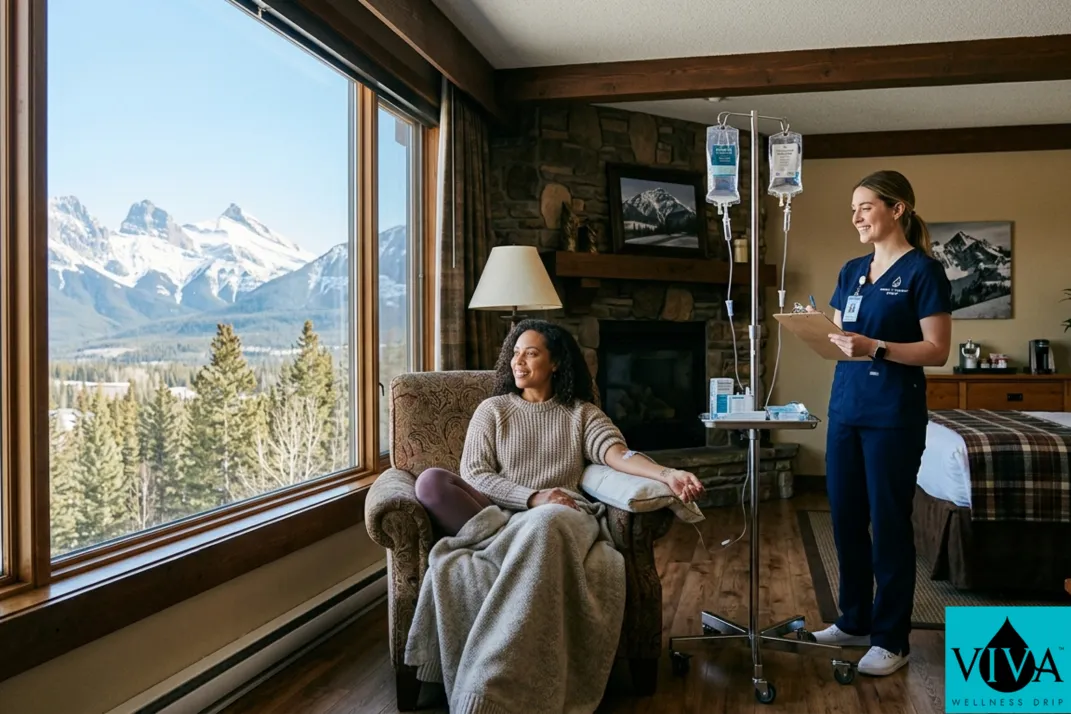
Why Oral Hydration Has Limits at Altitude
The standard advice — drink more water, take electrolytes — is correct as far as it goes. The problem is that at altitude, the gastrointestinal system is also under stress. Reduced oxygen availability slows digestive motility, which means oral fluids and supplements are absorbed more slowly and less completely than at sea level.
An intravenous infusion bypasses the digestive system entirely. Fluids, electrolytes, and therapeutic nutrients are delivered directly into the bloodstream at near-100% bioavailability — a delivery mechanism that doesn’t depend on gut function or metabolic state. For a skier at the end of a three-day Sunshine Village itinerary, or a trail runner recovering from a Rockies ultra, that clinical precision matters.
The Mayo Clinic identifies intravenous delivery as the gold standard for rapid fluid and nutrient replenishment specifically because absorption is independent of gastrointestinal function — an advantage that becomes particularly relevant when the digestive system is itself operating under altitude-related stress.
What Goes Into a Mountain Recovery Drip
Every formulation begins with an isotonic saline base — a sterile solution calibrated to match the body’s cellular environment, enabling rapid fluid absorption without inflammatory response. The therapeutic components layered on top are what make the session specific to mountain recovery.
Electrolyte and Fluid Restoration
Sodium, potassium, and magnesium are the primary electrolytes lost through accelerated respiration, sweat, and altitude-related fluid shifts. Magnesium is particularly critical in athletic and high-exertion contexts — it participates in over 300 enzymatic reactions, including muscle contraction, nerve transmission, and sleep quality regulation. PubMed-indexed research consistently identifies magnesium depletion as a key contributor to post-exertion cramping, poor recovery, and disrupted sleep — all common complaints after high-altitude physical output.
Intracellular absorption of these electrolytes through IV delivery reaches the muscle tissue itself, rather than the partial, time-delayed absorption that oral supplements provide.
Anti-Nausea and Headache Support
Altitude headache — a hallmark of acute mountain exposure — is driven by a combination of cerebral vasodilation, dehydration, and electrolyte imbalance. IV rehydration addresses the dehydration and electrolyte components directly and rapidly. For visitors to Banff who arrive from sea level and push straight into activity, a pre-emptive or early-response IV session can meaningfully reduce the severity and duration of altitude adjustment symptoms.
B-Vitamins and Oxidative Stress Recovery
High-altitude environments increase oxidative stress — the accumulation of free radical cellular damage that results from elevated UV exposure, physical exertion, and the metabolic demands of operating at elevation. High-dose Vitamin C, glutathione precursors, and B-complex vitamins address this at the cellular level. For multi-day mountain itineraries, these formulations support sustained performance rather than just single-session recovery.
How Mobile IV Therapy Works in Banff and the Bow Valley
In our experience working with clients in mountain and resort environments, the logistical fit of mobile IV therapy is particularly strong. After a full day on the mountain — whether that’s ski runs at Norquay, a backcountry approach in the Valley of the Ten Peaks, or a summer trail push to the Plain of Six Glaciers — the last thing anyone needs is another errand.
Mobile IV drip therapy in Banff means a registered medical professional comes to your lodge, hotel suite, or chalet. Formulations are reviewed by a supervising physician. Sessions run 45 to 60 minutes. A brief health assessment is completed before every appointment — certain conditions require clearance, which is standard clinical protocol for any medically directed IV service.
The team at Viva Wellness Drip brings this standard of care directly to the Bow Valley corridor, without requiring you to leave the mountain environment to access it. For visitors spending limited days in Banff, that matters — recovery time is trip time, and a session that comes to your accommodation doesn’t cost you a morning.
IV Drip Banff: Recovery Built for the Mountain Environment
The Bow Valley attracts a particular kind of person — one who plans their trips around elevation gain, powder days, and summit registers rather than poolside schedules. That physical ambition is exactly what makes deliberate recovery so important here. The body operating at altitude, under exertion, in dry cold air, is working harder than it does at sea level. It needs more support, not less.
IV therapy in Banff isn’t a luxury response to mild tiredness. It’s a clinically grounded tool for managing the specific physiological demands that mountain environments place on the body — and for ensuring that the next day on the mountain is as strong as the first.
Explore the full menu of IV drip services and find the formulation that fits where you are in your recovery right now. Whether you’re arriving from sea level and adjusting to altitude, midway through a multi-day itinerary, or winding down a season in the Rockies — the support is available, and it comes to you.
Frequently Asked Questions
What is mobile IV drip therapy and how does it work in Banff?
Mobile IV drip therapy delivers clinical-grade intravenous hydration and nutrients directly to your accommodation — lodge, hotel suite, or chalet. A licensed medical professional administers the session on-site over 45 to 60 minutes, with no clinic visit or travel required.
Why is IV therapy particularly useful for altitude recovery in the Bow Valley?
Altitude accelerates fluid and electrolyte loss through increased respiration and reduced atmospheric humidity — often before dehydration symptoms become obvious. IV therapy bypasses the digestive system to replenish fluids and electrolytes at near-100% bioavailability, addressing altitude-related depletion faster and more completely than oral hydration alone.
Can IV therapy help with altitude headaches in Banff?
Altitude headaches are commonly driven by a combination of dehydration, electrolyte imbalance, and cerebral vasodilation. IV rehydration addresses the dehydration and electrolyte components directly and rapidly, which can reduce the severity and duration of altitude adjustment symptoms — particularly for visitors arriving from sea level.
Is mobile IV therapy in Banff medically supervised?
Yes. Every session is administered by a registered nurse or paramedic and overseen by a licensed supervising physician. A health screening is completed before each appointment to confirm eligibility and ensure the formulation is appropriate for your specific recovery needs.
Who benefits most from IV drip therapy in Banff and the Bow Valley?
IV therapy is well-suited for skiers, hikers, trail runners, backcountry adventurers, and anyone adjusting to altitude after arriving from lower elevations. It’s particularly effective for multi-day mountain itineraries where cumulative physical output and altitude exposure create recovery deficits that oral hydration alone cannot address quickly enough.