Edmonton’s fitness culture has a particular character. It’s not the performative wellness of a coastal city — it’s functional, weather-hardened, and serious. The people training in this city do it in -25°C, on icy river valley trails, through the compressed summer that makes outdoor training feel urgent. They show up to CrossFit at 5:30 a.m. before oil sands shifts. They run half marathons in September slush. They play rec hockey three nights a week at 45 years old and expect their bodies to keep up.
What’s changing is the recovery side of that equation. More of Edmonton’s active community is recognising that output without deliberate replenishment is a compounding debt — and IV drip Edmonton is becoming the tool that serious trainers and weekend warriors alike are using to close that gap.
Why Edmonton Athletes Are Moving Beyond Oral Supplementation
The supplement industry has spent decades convincing active people that the right combination of powders, capsules, and recovery drinks will keep their bodies running at full capacity. For many Edmonton athletes, the honest assessment is that it hasn’t delivered — not because the compounds don’t work, but because oral delivery is an inherently limited pathway.
The gastrointestinal tract absorbs micronutrients at variable rates governed by gut health, competing nutrients, digestive enzyme availability, and current physiological stress. During and after intense training, blood flow is redirected away from the digestive system toward working muscles and recovery processes — meaning the window when your body needs nutrients most is also the window when oral absorption is least efficient.
IV therapy bypasses this entirely. An isotonic infusion delivers vitamins, minerals, and amino acid precursors directly into systemic circulation at near-100% bioavailability, reaching target tissues within minutes rather than hours. For athletes managing tight training schedules and compressed recovery windows, that difference is not marginal.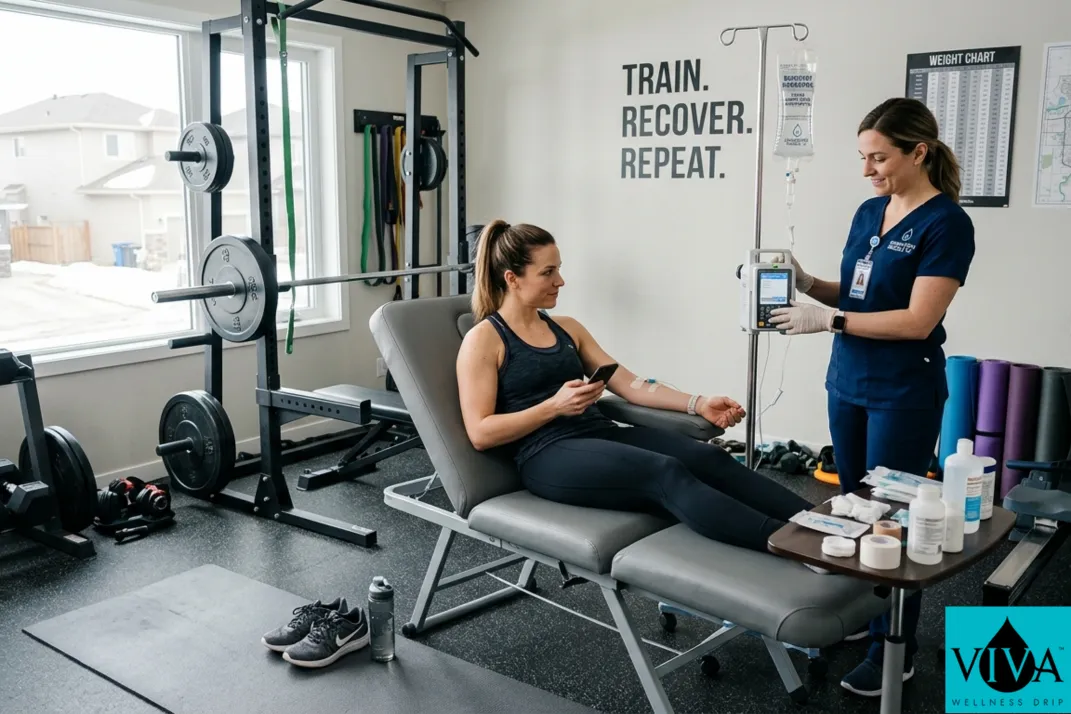
What the Research Says About IV Therapy and Athletic Performance
Magnesium and Muscle Recovery
Magnesium is the most consistently depleted mineral in active populations, lost through perspiration at rates that dietary intake rarely replaces adequately. Its role in athletic performance is foundational: magnesium governs neuromuscular transmission, regulates calcium’s role in muscle contraction, and acts as a cofactor in ATP synthesis — the cellular energy currency that powers every movement.
Research indexed through PubMed confirms intravenous magnesium’s effectiveness in reducing exercise-induced muscle fatigue and accelerating post-training recovery. For Edmonton athletes logging high training volumes — particularly those combining strength work with endurance events like the Edmonton Marathon — magnesium depletion is a real and measurable performance limiter that IV therapy addresses directly.
B Vitamins and Cellular Energy Production
The B-complex vitamins — particularly B1, B2, B3, B5, B6, and B12 — function as essential cofactors in the Krebs cycle and electron transport chain, the metabolic pathways that convert nutrients into usable cellular energy. Athletes running high training loads have elevated B-vitamin requirements that standard dietary intake often doesn’t meet, particularly during caloric restriction phases or competition prep.
Intravenous B12 delivery is especially significant for a subset of the population where intrinsic factor-dependent absorption in the gut is compromised — a condition that can remain subclinical for years while progressively eroding energy levels and neurological function. We’ve seen clients in their late thirties and forties who’ve been training consistently for years and plateaued in both performance and recovery — and whose breakthrough came from restoring B12 levels intravenously rather than adding more training volume.
Glutathione and Oxidative Stress Management
Intense exercise generates reactive oxygen species at a rate that the body’s endogenous antioxidant systems must neutralize to prevent cellular damage and prolonged inflammation. Glutathione is the body’s primary intracellular antioxidant, and its depletion under training stress is a central mechanism in exercise-induced fatigue and delayed-onset muscle soreness.
Research published via PubMed confirms glutathione’s role in managing oxidative stress — and intravenous glutathione precursor delivery replenishes this system at concentrations that oral N-acetylcysteine supplementation approaches only slowly. For athletes with competition timelines or back-to-back training weeks, the speed of IV replenishment is practically significant.
How Edmonton’s Training Community Is Structuring IV Therapy
Pre-Competition Loading
In the week before a significant event — a marathon, a powerlifting meet, a Spartan Race — IV therapy functions as a loading protocol. Arriving at the start line with optimal intracellular hydration, replete magnesium stores, and a glutathione baseline that isn’t already depleted from training stress is a measurable advantage over arriving depleted and relying on race-day nutrition to compensate.
In-Season Maintenance
For athletes competing or training continuously — hockey players through an eight-month season, CrossFit competitors running concurrent strength and conditioning blocks, endurance athletes in base-building phases — bi-weekly IV sessions function as maintenance rather than intervention. The goal is to prevent the micronutrient deficit from accumulating in the first place, not to recover from it after the fact.
Post-Event and Post-Race Recovery
The 24-to-48-hour window after a major physical effort is when IV therapy delivers its most immediate and perceptible results. The team at Viva Wellness Drip brings sessions directly to your home or hotel after the Edmonton Marathon finish line, after the tournament weekend, after the training camp — because that’s when the body needs it and when the last thing you have energy for is driving to a clinic.
The Mobile Advantage for Edmonton’s Athletic Community
Training schedules are already demanding. Adding a clinic commute to a recovery day defeats the purpose. Mobile IV drip therapy Edmonton integrates into an athlete’s routine without disrupting it — sessions happen at home, at the gym, or at team accommodation, administered by medically-directed professionals who bring all necessary equipment.
For team sports — hockey clubs, running groups, triathlon squads — mobile group sessions at a shared location make the logistics practical for everyone simultaneously. One booking, one location, multiple athletes recovering in parallel.
Recovery as a Performance Variable
The shift in how Edmonton’s active community thinks about recovery mirrors a broader global movement in sports science. Recovery isn’t passive — it’s a training variable with as much influence on performance outcomes as the sessions themselves. The National Institutes of Health has consistently reinforced the relationship between micronutrient status and physical performance capacity — and Edmonton’s climate makes maintaining that status through diet and oral supplementation alone particularly challenging across the winter months.
Athletes who treat IV therapy in Edmonton as infrastructure — scheduled, consistent, built into the training plan — report not just faster recovery but a sustained elevation in baseline performance that compounds over a season. That’s the shift worth making: from reactive to proactive, from recovery as afterthought to recovery as strategy.
Explore the full range of IV drip services and find the protocol that fits where your training is right now.
Frequently Asked Questions
How does IV drip therapy specifically benefit athletes training in Edmonton?
IV drip therapy delivers key performance nutrients — magnesium, B-complex vitamins, glutathione precursors, and electrolytes — directly into the bloodstream at near-100% bioavailability. For Edmonton athletes dealing with high training loads and cold-weather depletion, this restores the micronutrient baseline that oral supplementation often can’t maintain at pace.
When is the best time to schedule an IV drip session around training?
Both pre-competition loading — in the days before a major event — and post-training recovery sessions within 24 to 48 hours of significant effort are effective windows. For athletes in continuous training cycles, bi-weekly maintenance sessions prevent cumulative depletion rather than correcting it after the fact.
Is IV therapy safe for competitive athletes in Edmonton?
Yes, when administered by medically-directed professionals using standard clinical protocols. The compounds used — vitamins, minerals, amino acid precursors, saline — are naturally occurring and non-prohibited under standard athletic governing body rules. Athletes competing under WADA or specific sport federation rules should verify individual formulation components with their governing body.
How is IV magnesium delivery different from taking magnesium supplements orally?
Oral magnesium competes with other minerals for gastrointestinal absorption and is subject to the digestive system’s variable uptake rates, particularly when the body is under physical stress. IV delivery places magnesium directly into the bloodstream at therapeutic concentrations, bypassing absorption limits and producing measurable effects on muscle function within hours.
Can Edmonton sports teams or training groups book mobile IV therapy together?
Yes. Mobile group sessions can be arranged for multiple athletes at a shared location — a training facility, team accommodation, or private residence — with sessions administered sequentially. Advance booking is recommended for groups to coordinate timing and ensure availability, particularly during peak competition periods.