Rome asks more of your body than most cities do. Not because it’s hostile — quite the opposite — but because experiencing it properly is inherently physical. The city has no grid, no shortcuts, and very little flat ground. A serious day in Rome means kilometres of cobblestone through Trastevere, a climb to the Gianicolo, an afternoon navigating the Vatican Museums, and an evening that starts late and ends later. By any measure, that’s a significant physical output — and most people absorb it without a recovery plan.
For visitors pushing through a condensed itinerary and locals managing the city’s relentless rhythm of work, heat, and social obligation, IV drip Rome services offer something that rest and a litre of acqua frizzante cannot: clinical-grade replenishment delivered at the speed and precision the body actually needs.
Why Rome’s Environment Creates a Genuine Hydration Challenge
Rome’s climate is not forgiving in the summer months. Temperatures regularly exceed 35°C from June through August, and the city’s thermal mass — centuries of stone, marble, and terracotta absorbing and radiating heat — means that ambient temperature stays elevated well into the evening. Humidity fluctuates, but the combination of heat, physical movement, and limited shade along many of the city’s most-visited routes generates significant fluid and electrolyte loss throughout the day.
This is a physiological reality that affects both first-time visitors and long-term residents. According to research published by the National Institutes of Health, heat-related fluid loss accelerates electrolyte depletion — particularly sodium, potassium, and magnesium — in ways that outpace what most people replace through food and drink alone. Subclinical dehydration, the kind that hasn’t yet produced obvious thirst, measurably impairs cognitive function, physical performance, and mood — all before it becomes a medical concern.
For visitors on a limited itinerary, that impairment has a direct cost. A day of fatigue in Rome is a day of the Colosseum seen through fog, of the Borghese Gallery rushed, of the dinner at a neighbourhood trattoria in Pigneto that didn’t land because the energy wasn’t there.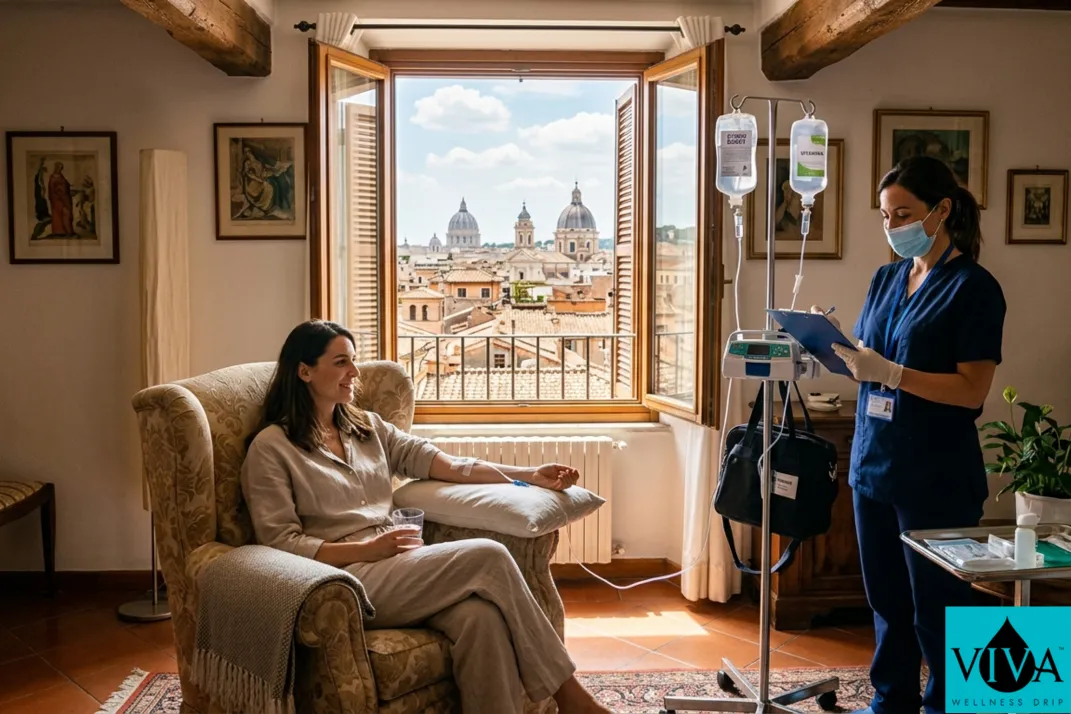
What IV Drip Therapy Rome Actually Delivers
The clinical case for IV therapy Rome rests on the delivery method. An intravenous infusion bypasses the digestive system entirely, delivering fluids and nutrients directly into the bloodstream at near-100% bioavailability. Oral hydration — water, electrolyte drinks, supplements — must pass through the gastrointestinal tract before reaching systemic circulation, a process that takes time and is subject to significant absorption variability depending on gut health, stress levels, and metabolic state.
Every IV session begins with an isotonic saline base: a sterile solution formulated to match the body’s cellular environment, enabling rapid fluid absorption without inflammatory response. The therapeutic components layered on top determine the clinical focus.
Electrolyte and Heat Recovery
Sodium, potassium, and magnesium restoration addresses the specific depletion profile created by heat exposure and sustained physical movement. Magnesium participates in over 300 enzymatic reactions — including muscle recovery, nerve signal transmission, and sleep quality regulation. PubMed-indexed research consistently identifies magnesium depletion as a primary contributor to post-exertion cramping, fatigue, and disrupted sleep — all common complaints after a demanding day in Rome’s summer heat.
B-Vitamins and Cognitive Clarity
B-complex vitamins support mitochondrial energy production and sustained neurological function. For Rome’s professional residents managing demanding schedules through the city’s long, hot working season — or for visitors trying to stay sharp across a packed cultural itinerary — intravenous B-vitamin delivery ensures the therapeutic dose reaches the bloodstream without the absorption variability of oral supplementation.
Immune and Oxidative Stress Support
Travel itself is immunologically stressful — airports, crowds, disrupted sleep, dietary changes, and timezone shifts all suppress immune function. High-dose Vitamin C and glutathione precursors address the oxidative stress that accumulates from that compound physiological load. For visitors arriving in Rome after long-haul travel, a session that addresses both jet lag and heat exposure simultaneously is clinically more efficient than addressing each in isolation.
How Mobile IV Therapy Works Across Rome
The team at Viva Wellness Drip brings medically directed IV therapy directly to your location — hotel suite near the Spanish Steps, apartment in Prati, villa rental in the EUR district, or serviced accommodation anywhere across the city. A registered nurse or paramedic administers the session. A supervising physician reviews the formulation. A brief health assessment is completed before every appointment — certain conditions require physician clearance, which is standard protocol for any medically directed IV service.
Sessions run 45 to 60 minutes. In our experience working with clients in dense, high-tourism urban environments, the mobile model removes the single biggest barrier to recovery: the energy required to seek it out. When you’re depleted after a full day in Rome, the last thing you need is a commute to a wellness clinic. The session comes to you — and that changes whether recovery actually happens.
For long-term Rome residents, the calculus is different but the conclusion is the same. The city’s pace — a culture that runs warm, stays late, and builds social obligation into the fabric of the week — makes consistent recovery more important and less convenient. Mobile IV drip therapy in Rome fits into that schedule rather than competing with it.
The Practical Details Before You Book
Eat something light before your session — arriving well-fasted isn’t necessary and can make some people feel lightheaded during infusion. Wear comfortable clothing with easy sleeve access. The session itself is genuinely low-effort; most clients rest, read, or catch up quietly during the infusion.
Post-session effects typically include clearer energy, reduced physical heaviness, and improved mental clarity within a few hours. The Mayo Clinic identifies intravenous delivery as the gold standard for rapid fluid and nutrient replenishment because absorption is not dependent on gastrointestinal function — a clinically meaningful advantage for anyone whose digestive system is operating under the stress of travel, heat, or sustained physical output.
IV Drip Rome: Recovery That Keeps Pace With the City
Rome rewards presence. The city’s history, food, light, and texture are best absorbed slowly — which requires a body that isn’t running on a deficit. Whether you’re a visitor with four days and a list of neighbourhoods to cover, or a resident who has learned to pace yourself against the city’s demands, IV therapy in Rome offers a recovery mechanism that works at the speed the situation requires.
Clinical hydration, electrolyte restoration, immune support, and energy replenishment — delivered to your door, administered by qualified professionals, matched to what your body actually needs. Explore the full menu of IV drip services and find the formulation that fits where you are right now. Rome will still be there when the session is done — and you’ll be ready for it.
Frequently Asked Questions
What is mobile IV drip therapy and how does it work in Rome?
Mobile IV drip therapy delivers clinical-grade intravenous hydration and nutrients directly to your location — hotel, apartment, or villa. A licensed medical professional administers the session on-site over 45 to 60 minutes, with no clinic visit or commute required.
Why is hydration particularly important for visitors to Rome?
Rome’s summer heat, cobblestone terrain, and densely packed itineraries generate significant fluid and electrolyte loss throughout the day — often before dehydration symptoms become obvious. IV therapy replenishes fluids and electrolytes at near-100% bioavailability, restoring function faster than oral hydration alone.
Can IV therapy help with jet lag and travel fatigue in Rome?
Yes. Travel suppresses immune function and creates compound physiological stress — dehydration, electrolyte imbalance, disrupted sleep, and oxidative load. IV therapy addresses the fluid and nutrient components of that state directly, shortening the recovery window in a way that rest and oral hydration cannot match on their own.
Is mobile IV therapy in Rome medically supervised?
Yes. Every session is administered by a registered nurse or paramedic and overseen by a licensed supervising physician. A health screening is completed before each appointment to confirm eligibility and ensure the formulation is appropriate for your specific recovery needs.
Who benefits most from IV drip therapy in Rome?
IV therapy is well-suited for tourists managing demanding itineraries in summer heat, long-term residents navigating Rome’s high-output professional and social calendar, and travellers recovering from jet lag or long-haul flights. It’s particularly effective when recovery time is limited and the next day demands full physical and cognitive function.