Quick Take (TL;DR)
- Oral supplements hit a hard absorption ceiling — one that no dosage increase can overcome once intestinal transporters are saturated
- High-performance professionals are transitioning to targeted IV infusions because the return on investment — measured in cognitive output, recovery speed, and sustained energy — is demonstrably higher
- Mobile IV drip therapy makes this transition frictionless: clinical-grade infusions delivered to your home, hotel, or office by a registered nurse
- The side effects of IV drip therapy are minimal and well-managed; the real cost of not transitioning is the performance gap you’ve normalized
- Viva Wellness Drip provides medically-directed mobile IV therapy built for clients who measure outcomes — not just intentions
The Supplement Stack That Looks Impressive but Delivers Less Than You Think
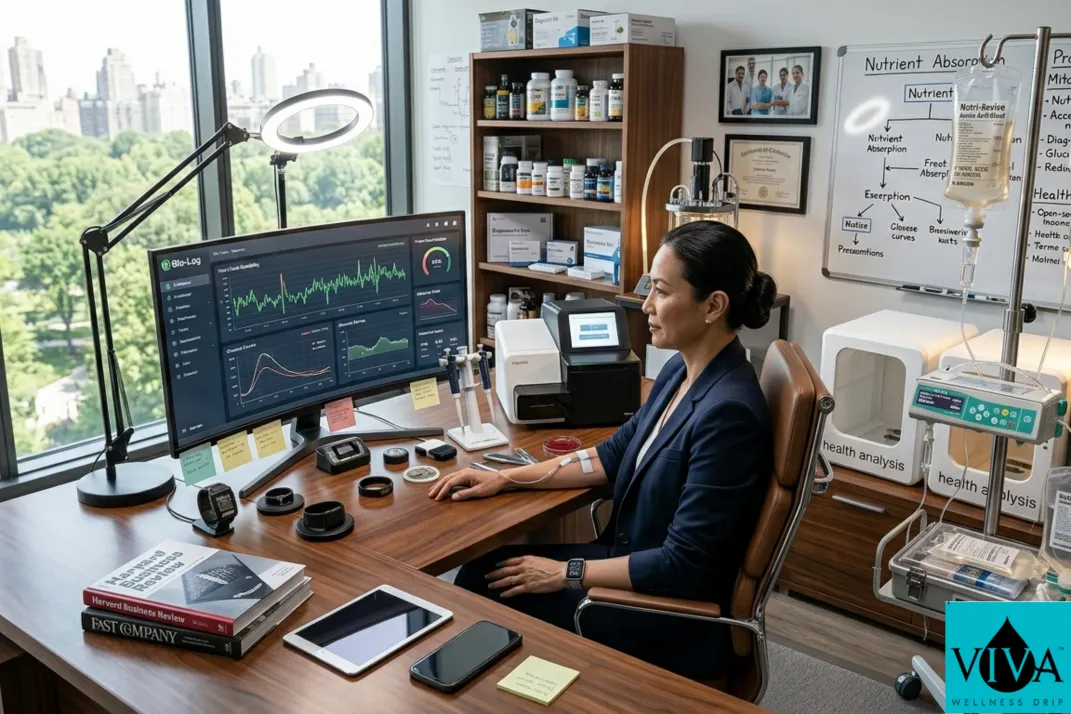
Walk into the home of any serious high-performance professional and you’ll likely find a supplement cabinet that reads like a clinical formulary. Methylated B12. Magnesium glycinate. Liposomal Vitamin C. NAD+ precursors. Adaptogens. CoQ10.
The investment is real. The intention is rigorous. And in my experience, the results are — for many of these clients — consistently underwhelming relative to what they’re spending and the discipline they’re applying.
The reason isn’t the quality of the supplements. It’s the pipeline.
Every compound in that cabinet faces the same journey: dissolve in the gut, survive gastric acid, compete for finite intestinal transporter capacity, survive hepatic first-pass metabolism, then arrive in systemic circulation at a fraction of the original dose — and finally compete with other compounds for the same intracellular transport channels. By the time the nutrient reaches the cell that needed it, you’ve lost a significant portion of what you paid for.
Intravenous delivery eliminates this journey entirely. The compound enters your bloodstream directly. Bioavailability approaches 100%. The cell receives what you intended to give it, at the concentration that produces a clinical outcome — not a background effect.
This is the transition that high-performance professionals are making in 2026. Not away from nutrition — toward a delivery mechanism that actually works at the scale their demands require.
The Five Performance Gaps That IV Infusions Address That Oral Supplements Cannot
Gap 1: Cognitive Output Under Sustained Pressure
The brain’s demand for micronutrients under sustained cognitive load exceeds what most professionals are meeting through diet and oral supplementation.
- B vitamins — particularly B1 (thiamine), B6, and B12 — are essential co-factors for neurotransmitter synthesis (dopamine, serotonin, acetylcholine) and myelin maintenance. Deficiencies that don’t register as “low” on standard bloodwork still blunt processing speed, working memory, and stress resilience.
- Magnesium regulates NMDA receptor activity — the molecular gateway for synaptic plasticity and learning. The WHO estimates up to 60% of adults in developed countries consume below recommended daily intake, and intestinal tolerance limits how much oral magnesium can be delivered before causing GI distress.
- IV delivery saturates plasma levels of both compounds within minutes of session start, driving intracellular absorption into neural tissue at concentrations that produce measurable cognitive effects — not just theoretical nutritional adequacy.
Pro Tip: For professionals preparing for high-stakes events — board presentations, investor meetings, multi-day conferences — a B-complex and magnesium IV session 12–18 hours beforehand pre-loads the neurotransmitter co-factors that sustained mental performance depletes. It’s not a stimulant. It’s substrate. You’re giving your brain the raw materials it needs before it has to spend them.
Gap 2: Recovery Velocity After Physical and Cognitive Exertion
Recovery is not rest — it’s an active biochemical process that requires specific inputs. Two of the most critical are consistently under-delivered by oral routes.
- Glutathione — synthesized from glutathione precursors (cysteine, glycine, glutamine) — is the primary antioxidant responsible for clearing exercise- and stress-generated reactive oxygen species. Oral glutathione is largely degraded before reaching systemic circulation. IV delivery elevates plasma glutathione measurably within the session window.
- Vitamin C at therapeutic concentrations (achievable only via IV) drives collagen repair in connective tissue and vascular walls — directly accelerating the tissue remodelling that determines how quickly you’re physically functional again after exertion.
For professionals whose calendar doesn’t allow a 48-hour recovery window after a demanding week, IV therapy compresses the biochemical recovery curve in ways no oral protocol achieves.
Gap 3: Immune Resilience During High-Travel, High-Stress Periods
Frequent international travel is one of the most immunologically costly professional activities that exists — and one of the most common among the clients who need IV therapy most.
- Cabin pressure reduces oxygen saturation by 10–15%, stressing red blood cell function
- Circadian disruption from time zones suppresses natural killer (NK) cell activity, according to research published in Nature Reviews Immunology
- The physical proximity of air travel creates exposure risk at precisely the moment immune defence is weakened
High-dose intravenous Vitamin C — achieving plasma concentrations up to 70 times higher than the equivalent oral dose, as documented in Nutrients (2020) — activates NK cells and supports the interferon-mediated antiviral response at concentrations that matter. The Super Immune IV from Viva Wellness Drip combines high-dose Vitamin C with zinc and immune-targeted co-factors in a formulation designed specifically for this immune loading context.
Gap 4: Metabolic Baseline Maintenance Under Chronic Stress
Chronic professional stress has a specific metabolic signature that oral supplements rarely correct fast enough to matter.
- Cortisol chronically elevates blood glucose, accelerating the glycation of proteins — a process directly associated with accelerated biological aging and cognitive decline
- Adrenal Vitamin C depletion occurs during sustained cortisol production — the adrenal glands have among the highest Vitamin C concentrations of any tissue in the body and deplete rapidly under chronic activation
- Zinc and B6 are consumed by cortisol metabolism pathways, reducing the substrate available for serotonin and dopamine synthesis — which is why chronic stress produces both immune vulnerability and mood dysregulation simultaneously
IV replenishment of these compounds under high-cortisol conditions restores the biochemical baseline that oral supplementation, constrained by absorption limits, cannot restore at the required rate.
Pro Tip: If your calendar has run three consecutive high-demand weeks — back-to-back travel, quarterly close, a demanding client pitch cycle — don’t wait for symptoms to justify an IV session. Schedule it proactively on the Friday before the fourth week. Biochemical depletion compounds; the session that prevents the crash costs significantly less — in time, in capability, and in recovery — than the session that rescues you from it.
Gap 5: Skin and Physical Presentation Under Public Scrutiny
For senior professionals, physical presentation is a performance variable with real professional stakes. It signals energy, competence, and self-investment.
- Dehydration at the cellular level — extracellular fluid depletion that oral water intake corrects only gradually — produces the dull, slightly sunken appearance that no topical product corrects from the outside
- Glutathione’s role in melanin regulation (inhibiting tyrosinase activity) and Vitamin C’s role in collagen synthesis both target the dermal layer in ways that skincare cannot reach
- Isotonic IV solutions restore plasma volume and re-establish osmotic gradients that drive intracellular hydration — the mechanism behind the “glow” that clients consistently report following IV skin protocols
The iv drip for glowing skin outcomes that have made glutathione and Vitamin C IV protocols so sought-after are not cosmetic mythology. They are the visible surface expression of cellular rehydration and antioxidant replenishment operating at a tissue level.
Oral Supplements vs. Targeted IV Infusions: The Professional’s Comparison
| Performance Variable | Oral Supplements | Targeted IV Infusions |
| Bioavailability | 20–50% (dose and compound dependent) | ~100% |
| Onset of cognitive effect | 45–90 minutes (if absorbed) | 10–20 minutes |
| Therapeutic Vitamin C plasma level | ~200 μmol/L maximum | Up to 20,000 μmol/L |
| Magnesium delivery without GI distress | Limited by intestinal tolerance | Unconstrained |
| Glutathione systemic delivery | Largely degraded pre-absorption | Direct plasma elevation |
| Recovery from cortisol depletion | Days to weeks at oral dosing rates | Hours at IV concentrations |
| Skin hydration mechanism | Topical/indirect | Intracellular via osmotic restoration |
| Scheduling flexibility | Daily pill habit required | Monthly protocol, delivered to you |
IV Drip Side Effects Through a Professional’s Risk Lens
High-performance professionals are accustomed to managing risk with clear information. Here is the complete, honest profile of iv drip therapy side effects:
- Bruising at the insertion site: The most common reported side effect. Minor, resolves within 2–5 days, entirely technique-dependent. An experienced RN minimizes this significantly.
- Niacin flush (B3): A harmless vasodilatory response causing temporary warmth and redness. Expected with B-complex formulations. Self-resolves within 20–30 minutes.
- Mild lightheadedness: Occasionally reported by significantly dehydrated clients as plasma volume is rapidly restored. Lying down during the session prevents it entirely.
- IV drip for skin side effects (glutathione/Vitamin C): At standard wellness doses, both are well-tolerated. G6PD deficiency — a contraindication for high-dose glutathione — is identified during pre-session health clearance.
- Fluid overload risk: Present only in clients with cardiac or renal compromise. Pre-session health screening by a Nurse Practitioner identifies and screens for this.
- Serious adverse events: Rare. Concentrated almost entirely in unqualified providers operating without medical oversight.
The pattern is consistent: the side effects of IV drip therapy are low-severity and manageable. The risk concentrates in the provider variable — which you control entirely through your booking decision.
Pro Tip: If you’re a professional whose schedule involves back-to-back public-facing commitments, book your IV session on an evening rather than a morning to avoid the small possibility of visible niacin flush (the temporary redness from B3) interfering with how you present in a meeting. For most clients the flush is mild and brief, but timing your first few sessions for lower-visibility windows lets you calibrate your personal response before relying on it before a keynote.
The 2026 Context: IV Therapy as Career Infrastructure
The healthspan movement has fundamentally reframed how serious professionals think about health investment. It’s no longer about preventing disease in retirement. It’s about maintaining peak cognitive, physical, and metabolic function throughout the decades that actually define a career.
The damp drinking movement has added another dimension — professionals who participate in the social rituals of their industry (client dinners, networking events, celebrations) while managing recovery intelligently. A targeted IV session the morning after a late night doesn’t enable excess — it minimizes the metabolic debt of an occasional social evening, preserving the productive days that follow.
Mobile IV drip therapy delivers both of these protocols without requiring a clinic visit, a fixed schedule, or a compromise in care quality. The Anxiety Relief IV — combining magnesium, B-complex, and targeted calming compounds — addresses the specific neurological cost of sustained professional stress. The NAD+ Boost IV sits at the frontier of cellular longevity investment, delivering the mitochondrial co-enzyme that oral precursors approach but IV delivery achieves.
At Viva Wellness Drip, every session is formulated by a licensed Medical Director and administered by a registered nurse — the clinical infrastructure that converts a wellness interest into a reliable performance protocol.
Frequently Asked Questions
Why are professionals choosing mobile IV drip therapy over oral supplements?
Because bioavailability is the decisive variable. Oral supplements consistently deliver 20–50% of their labelled dose to systemic circulation. IV therapy delivers near-100%. For professionals managing demanding cognitive and physical schedules, that efficiency gap translates directly into measurable performance differences — in recovery speed, cognitive clarity, and immune resilience.
What are the side effects of IV drip therapy professionals should know about?
The most common are mild bruising at the insertion site, a transient niacin flush with B-vitamin formulations, and occasional lightheadedness in dehydrated clients. All are minor and self-resolving. Serious side effects are rare and tied almost entirely to unqualified providers or unscreened contraindications — both eliminated by booking a medically-directed service with RN administration.
How does mobile IV drip therapy fit a demanding professional schedule?
A session runs 30–45 minutes. A registered nurse comes to your home, office, or hotel — no clinic visit, no commute, no waiting room. Most clients schedule during a work-from-home morning or over a lunch window. The session requires no recovery time; most clients return to full productivity within an hour of completion.
Are there specific iv drip for skin side effects that professionals should know about?
At standard doses, glutathione and Vitamin C IV protocols are well-tolerated. G6PD deficiency is the primary contraindication for glutathione, identified during pre-session health clearance. The visible outcomes — improved skin tone, reduced puffiness, enhanced radiance — typically become consistent after 3–4 sessions on a regular protocol, not after a single treatment.
What is the best IV drip formulation for a professional starting out?
A Myers’ Cocktail provides the broadest coverage per session — magnesium, B-complex, Vitamin C, calcium — addressing the widest range of stress- and travel-related depletions in one well-studied formulation. It’s the rational starting point for any professional building their first IV protocol: high signal-to-noise ratio, excellent tolerability, and a strong base from which to customize.