Glasgow doesn’t perform for visitors the way some cities do. It doesn’t arrange itself around a single iconic landmark or present a curated version of itself for external consumption. What it offers instead is something more substantial — a city of genuine texture, working energy, and a cultural life that runs deep: the Burrell Collection, the Kelvingrove, the music venues of Sauchiehall Street and the Barras, the restaurant scene in the Merchant City that has earned the city a culinary reputation it once seemed unlikely to hold. Glasgow works hard and plays harder, and the people who live here tend to approach both with the same directness.
That combination — physical output, professional intensity, and a social culture that takes its own commitments seriously — creates a recovery profile that most Glaswegians manage on grit alone. IV drip Glasgow services offer a more clinically grounded alternative: mobile IV therapy delivered to your door, calibrated to what the city and its climate actually ask of the body.
Glasgow’s Climate and What It Does to the Body Year-Round
Glasgow sits on the west coast of Scotland, and its weather reflects that geography without apology. The city receives more rainfall than almost anywhere else in the UK, and the Atlantic systems that move in from the west bring persistent damp, wind, and cold that settles into a long grey season stretching from October through April. Average winter temperatures sit between 2°C and 8°C, but the felt temperature — factoring in the wind off the Clyde and the humidity that Glasgow’s west coast position produces — runs consistently lower.
Cold, damp conditions are physiologically demanding in ways that don’t always register consciously. The body expends considerable metabolic energy maintaining core temperature in sustained cold, drawing from the same reserves that cognitive performance, immune function, and physical recovery depend on. According to research published by the National Institutes of Health, cold climate exposure and sustained psychological stress accelerate the depletion of magnesium, B-vitamins, and Vitamin C — the micronutrients most central to energy metabolism, immune resilience, and neurological function.
For Glasgow’s working population — across healthcare, engineering, education, the creative industries, and the substantial service sector that runs the city’s economy — that depletion compounds across a demanding year in a way that standard recovery approaches rarely address adequately.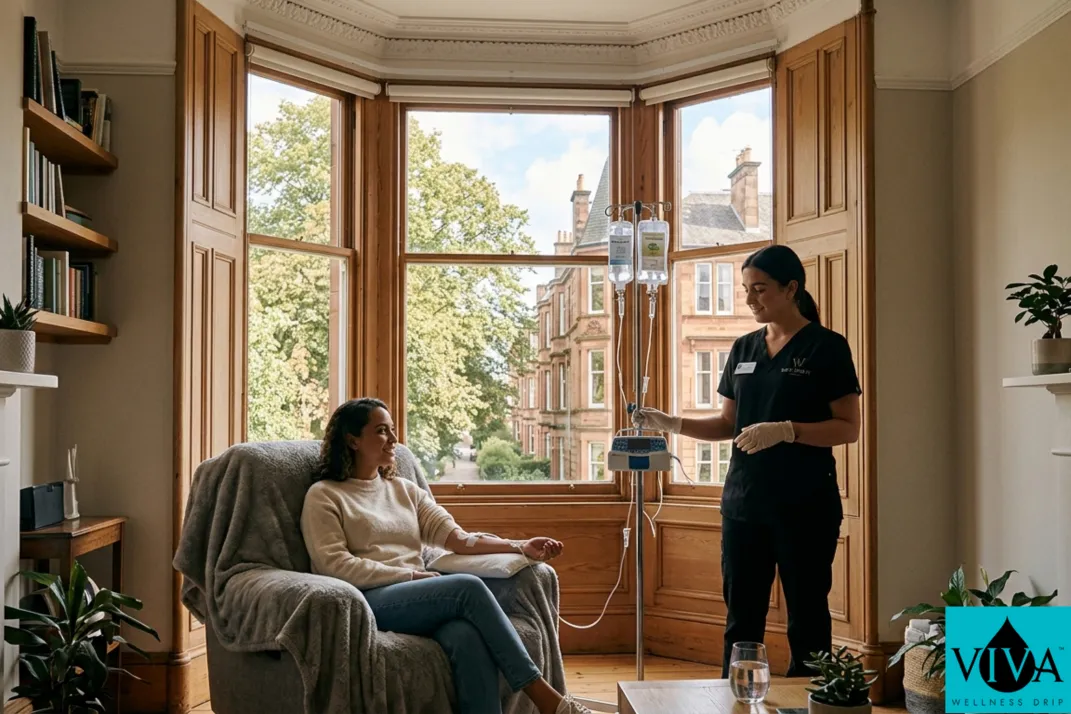
What Mobile IV Therapy Actually Involves
If you haven’t used a mobile IV service before, understanding the process is the most useful preparation. The experience is more straightforward and more clinical than most people expect — and understanding what happens removes the uncertainty that often delays a first booking.
A registered nurse or paramedic arrives at your home, hotel, or workplace at the scheduled time. A brief health assessment is completed before the infusion begins — formulations are reviewed by a supervising physician, and certain medical conditions require clearance before IV therapy proceeds. This is standard protocol for any medically directed service, and it’s the clinical safeguard that makes the care legitimate.
The infusion runs 45 to 60 minutes. Every formulation begins with an isotonic saline base — a sterile solution calibrated to match the body’s cellular environment, enabling rapid fluid absorption without inflammatory response. The therapeutic components layered on top are specific to the recovery need identified in the health assessment.
Wear comfortable clothing with easy sleeve access and eat something light beforehand. Most clients rest, read, or simply decompress during the session. Post-session effects — clearer energy, reduced physical heaviness, improved cognitive clarity — typically emerge within a few hours.
The Formulations Most Relevant to Glasgow
Cold Climate Immune Defence
Glasgow’s west coast climate makes immune resilience a year-round operational requirement. The city’s long, wet winters, its density of shared indoor environments — offices, universities, transport — and the immune pressure of a large urban population in sustained cold create conditions where immune suppression is both common and costly. High-dose Vitamin C and glutathione precursors address oxidative stress and support cellular immune function, providing the proactive immune support that oral supplementation cannot match for absorption speed or efficiency.
PubMed-indexed research consistently identifies Vitamin C and glutathione depletion as contributors to increased respiratory illness susceptibility in cold-climate urban populations — a finding directly relevant to a city where winter runs long and the outdoor environment is genuinely demanding.
B-Vitamins and Sustained Energy
B-complex vitamins — B12, B6, and the full B-family — support mitochondrial energy production and neurological function. For Glasgow’s professional community managing demanding workloads across the city’s diverse economic sectors, B-vitamin depletion is a quiet and common contributor to the afternoon energy crashes and persistent cognitive fog that accumulate across a long working week. Intravenous delivery ensures the therapeutic dose reaches systemic circulation at the intended concentration — bypassing the absorption variability of oral supplementation under stress.
Electrolyte Restoration and Physical Recovery
Sodium, potassium, and magnesium are the primary electrolytes involved in muscle contraction, nerve signal transmission, and fluid balance regulation. Magnesium participates in over 300 enzymatic reactions — including cortisol regulation, sleep quality, and the neurological recovery that sustained performance depends on. For Glasgow residents who are physically active — running along the Clyde, cycling the canal towpaths, training at the Commonwealth Games legacy facilities in the East End — magnesium restoration at the intracellular level delivers the depth of recovery that oral supplements rarely achieve consistently.
Concert and Event Recovery
Glasgow is one of the UK’s premier live music cities — the SSE Hydro, the O2 Academy, King Tut’s Wah Wah Hut, and the Celtic Connections festival that takes over the city each January collectively make Glasgow a city where late nights around live performance are a genuine part of the cultural fabric. In our experience working with clients in cities with strong live music and events cultures, the recovery profile of a full concert or festival evening is specific: fluid loss in warm indoor venues, B-vitamin and electrolyte depletion, and the disrupted sleep that late nights produce when the body hasn’t had adequate preparation or recovery support. A targeted IV session the following morning addresses that compound depletion efficiently and completely.
How the Service Works Across Glasgow
The team at Viva Wellness Drip brings medically directed IV therapy directly to your location across Glasgow — a West End flat in Hyndland or Partick, a hotel suite in the city centre, a serviced apartment in Finnieston, or a residence anywhere across the wider Greater Glasgow area. A registered nurse or paramedic administers every session under physician supervision.
Glasgow’s geography — compact enough to navigate, extensive enough to serve a full metropolitan population — makes the mobile model practically efficient across the city’s diverse residential and commercial districts. The session arrives at your door. The formulation is matched to your specific need. There is no commute in either direction when you’re already running low.
The Mayo Clinic identifies intravenous delivery as the gold standard for rapid fluid and nutrient replenishment because absorption is independent of gastrointestinal function — a clinically meaningful advantage for anyone whose body is managing the compound demands of a west coast Scottish winter, a demanding professional schedule, and a social and cultural life that Glasgow takes seriously.
IV Drip Glasgow: Recovery That Matches the City’s Standard
Glasgow has always done things its own way — directly, without unnecessary ceremony, and to a standard that doesn’t require external validation. Mobile IV drip therapy in Glasgow fits that character precisely: clinical quality delivered efficiently, on your schedule, at your door, without the friction that makes recovery feel like another obligation in an already full week.
Whether you’re managing the immune pressure of a Scottish winter, maintaining energy through a demanding professional stretch, recovering from a late night at the Hydro, or simply ensuring that the next week starts from a better physiological position than the last one ended — IV therapy in Glasgow delivers the clinical support your body needs in a format that respects how this city actually operates.
Explore the full menu of IV drip services and find the formulation that fits what your body needs right now. Glasgow will still be exactly itself when the session is done — which is precisely the point.
Frequently Asked Question
What is mobile IV drip therapy and how does it work in Glasgow?
Mobile IV drip therapy delivers clinical-grade intravenous hydration and nutrients directly to your location — flat, hotel suite, or workplace. A licensed medical professional administers the session on-site over 45 to 60 minutes, with no clinic visit or commute required.
Why is IV therapy particularly relevant for Glasgow’s climate and lifestyle?
Glasgow’s west coast weather — persistent cold, damp, and wind across a long winter — accelerates depletion of the micronutrients most central to immune function, energy metabolism, and cognitive performance. IV therapy replenishes those nutrients at near-100% bioavailability, supporting sustained function through a demanding Scottish year.
How does IV drip therapy help with recovery after Glasgow’s live music and events scene?
Late nights at live venues generate fluid loss, electrolyte depletion, and disrupted sleep that compound when not addressed specifically. IV rehydration and nutrient replenishment the following morning restores electrolyte balance and B-vitamin levels at near-100% bioavailability — addressing the recovery deficit faster and more completely than oral hydration alone.
Is mobile IV therapy in Glasgow medically supervised?
Yes. Every session is administered by a registered nurse or paramedic and overseen by a licensed supervising physician. A health screening is completed before each appointment to confirm eligibility and ensure the formulation is clinically appropriate for your specific recovery needs.
Who benefits most from IV drip therapy in Glasgow?
IV therapy is well-suited for working professionals managing Glasgow’s demanding economic and social calendar, physically active residents navigating the west coast climate, live music and events attendees managing late-night recovery, and anyone whose schedule makes consistent recovery difficult to prioritise without a service that comes to them.